
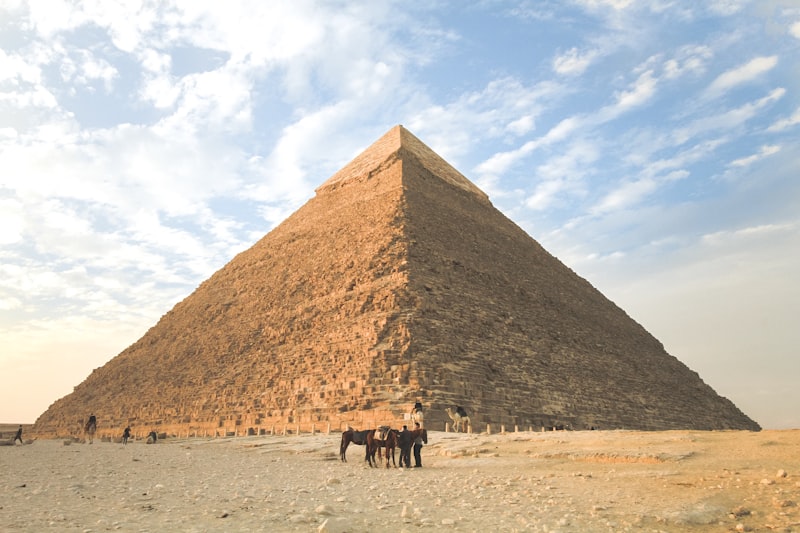
The civilization that built the pyramids continues to baffle archaeologists with unsolved mysteries spanning five millennia.
Unsolved Mysteries
1. How were the pyramids built? Despite decades of research, the exact method for lifting and placing the 2.3 million stone blocks of the Great Pyramid —each weighing 2.5-15 tons —remains uncertain. The pyramid was built in just 20 years, meaning a block had to be placed approximately every 5 minutes around the clock.
2. The Great Pyramid was originally covered in highly polished white limestone casing stones that made it shine brilliantly in the sun. An earthquake in 1303 CE loosened many of these stones, which were then used to build mosques and fortresses in Cairo.
3. The Sphinx shows evidence of water erosion, suggesting it may be far older than mainstream archaeology claims —possibly dating back to 7000-5000 BCE when Egypt had a much wetter climate.
Royal Secrets
4. Tutankhamuns tomb was discovered almost intact in 1922 by Howard Carter. It was one of the smallest royal tombs, likely because Tutankhamun died unexpectedly at age 19 and a more modest tomb was used hastily.
5. Cleopatra VII lived closer in time to the Moon landing (1969) than to the construction of the Great Pyramid (c. 2560 BCE). She is more chronologically our contemporary than she was the pyramids.
6. Egypt was ruled by women several times. Hatshepsut, one of the most successful pharaohs, ruled for over 20 years as a female king. Her successors attempted to erase her from history by chiseling her name and images off monuments.
Technology and Culture
7. Ancient Egyptians invented the 365-day calendar around 4200 BCE, dividing the year into 12 months of 30 days plus 5 festival days. This system was remarkably accurate.
8. Egyptian mummification was so effective that scientists have been able to extract DNA from mummies over 4,000 years old. The process involved removing internal organs, drying the body with natron salt for 40 days, and wrapping it in hundreds of yards of linen.
9. The first recorded labor strike in history occurred in ancient Egypt around 1152 BCE. Workers building the royal necropolis at Deir el-Medina went on strike when their food rations were delayed.
Enduring Mysteries
10. The construction of the pyramids required knowledge of advanced mathematics, including Pi and the golden ratio, which appear in the Great Pyramids proportions. Whether this was intentional or coincidental is debated.
11. The Great Pyramid was the tallest human-made structure on Earth for over 3,800 years —from its completion around 2560 BCE until the Lincoln Cathedral spire was built in 1311 CE.