
Ancient China is one of the world's oldest continuous civilizations, spanning over 5,000 years of history. Behind its famous Great Wall and Terracotta Warriors lie countless secrets, innovations, and stories that shaped not only China but the entire world.
Early Dynasties and Foundations
1. The Xia Dynasty, traditionally dated to 2070-1600 BCE, was long considered mythical by Western historians. However, archaeological discoveries at Erlitou in Henan Province have revealed a sophisticated Bronze Age civilization with palaces, bronze casting workshops, and a complex social hierarchy that matches the legendary descriptions of the Xia.
2. The Shang Dynasty (1600-1046 BCE) produced the earliest known Chinese writing, inscribed on oracle bones -- turtle shells and animal scapulae used for divination. Over 150,000 oracle bone fragments have been discovered, containing the ancestors of modern Chinese characters and revealing detailed records of royal life, warfare, and astronomy.
3. The Zhou Dynasty (1046-256 BCE) lasted nearly 800 years, making it the longest-ruling dynasty in Chinese history. It was during this period that the philosophical foundations of Chinese civilization -- Confucianism, Daoism, and Legalism -- were established during the Hundred Schools of Thought era.
Inventions and Technology
4. Paper was invented in China around 105 CE by Cai Lun, a court official of the Han Dynasty. However, archaeological evidence suggests paper-like materials existed as early as the 2nd century BCE. The invention revolutionized communication, record-keeping, and art, and the technology remained a closely guarded secret for centuries before spreading along the Silk Road.
5. The Chinese invented gunpowder in the 9th century while searching for an elixir of immortality. The earliest recorded formula -- a mixture of sulfur, charcoal, and saltpeter -- was documented by Taoist alchemists. By the 11th century, gunpowder was being used in military applications including fire arrows, bombs, and the world's first rockets.
6. The compass was developed in China during the Han Dynasty (206 BCE - 220 CE), originally using lodestone to create south-pointing spoons for geomancy and divination. By the Song Dynasty (960-1279 CE), mariners were using floating-needle compasses for navigation, centuries before the technology reached Europe.
7. Movable type printing was invented by Bi Sheng around 1040 CE, using individual ceramic characters that could be rearranged for each page. This was over 400 years before Johannes Gutenberg's printing press in Europe. However, the sheer number of Chinese characters (tens of thousands) made the system less practical than woodblock printing.
Engineering Marvels
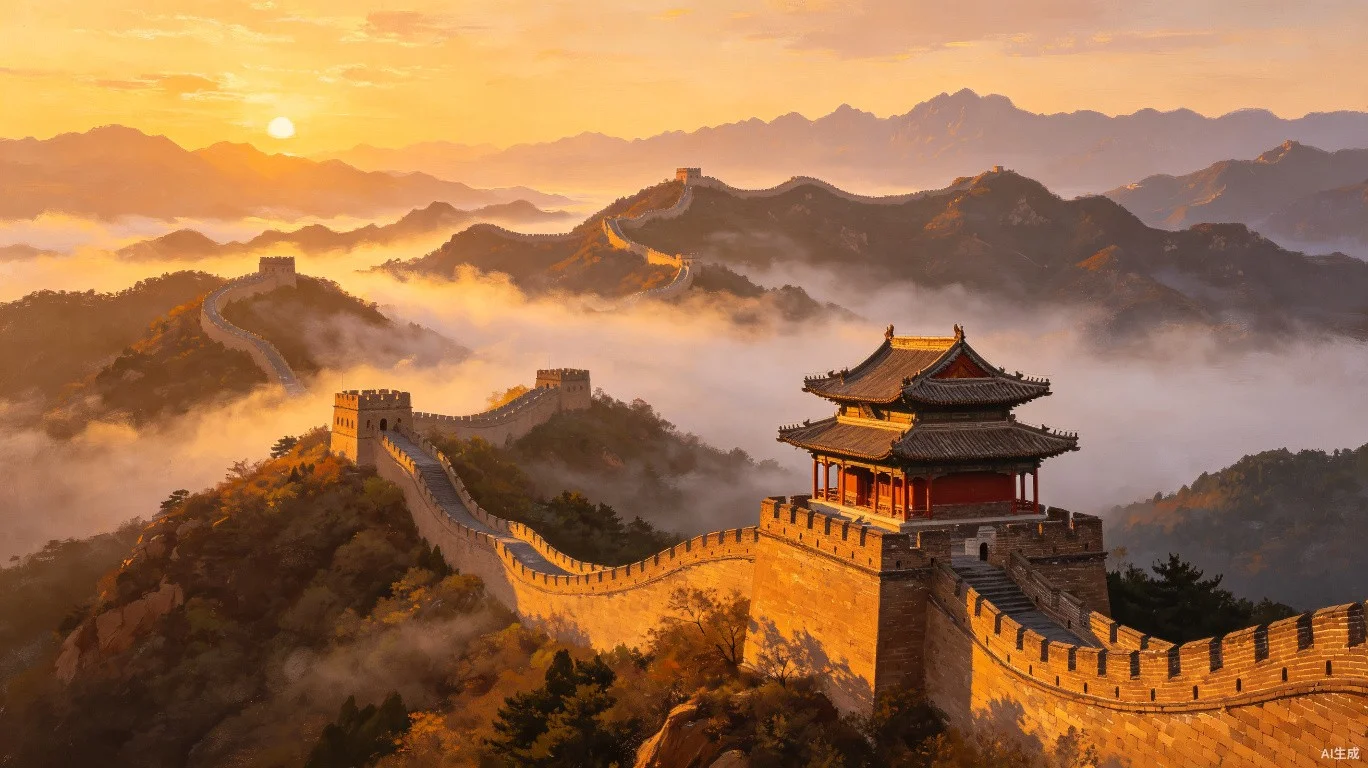
8. The Great Wall of China is not a single wall but a network of fortifications built and rebuilt over 2,000 years by multiple dynasties. The most famous sections were constructed during the Ming Dynasty (1368-1644). The total length of all Great Wall branches is approximately 21,196 kilometers, enough to circle half the Earth's equator.
9. The Grand Canal, the world's longest artificial waterway at over 1,776 kilometers, was begun in the 5th century BCE and substantially expanded during the Sui Dynasty (581-618 CE). It connected the Yellow River and Yangtze River, enabling grain transport from the fertile south to the political capital in the north, and remains in use today.
10. The Dujiangyan irrigation system, built around 256 BCE in Sichuan Province, is an engineering masterpiece that still functions after more than 2,200 years. Unlike a conventional dam, it uses a clever system of levees, channels, and spillways to control water flow and prevent flooding without blocking the river, preserving the local ecosystem.
The Terracotta Army and Imperial Tombs
11. The Terracotta Army of Qin Shi Huang, the first emperor of a unified China, consists of over 8,000 life-sized soldiers, 130 chariots with 520 horses, and 150 cavalry horses. Each warrior has unique facial features, suggesting they were modeled on real individuals. The tomb complex covers approximately 56 square kilometers.
12. Qin Shi Huang's tomb remains unexcavated because ancient texts describe rivers of mercury flowing through a model of his empire on the tomb floor. Modern soil tests have confirmed mercury concentrations up to 100 times normal levels, suggesting the historical accounts may be accurate and adding a hazardous dimension to any future excavation.
13. The Ming Dynasty tombs near Beijing contain 13 of the 16 Ming emperors. The Sacred Way leading to the tombs is lined with 36 stone statues -- 12 human figures (civil and military officials) and 24 animals -- believed to serve the emperor in the afterlife. The site was chosen based on feng shui principles, with mountains protecting the tombs on three sides.
Culture and Daily Life
14. Silk production was such a closely guarded secret in ancient China that revealing silkworm eggs or mulberry seeds to foreigners was punishable by death. The Silk Road, named after this prized commodity, connected China to the Mediterranean world for over 1,500 years, facilitating the exchange of goods, ideas, technologies, and religions.
15. The Forbidden City in Beijing, built between 1406 and 1420, contains 980 buildings with approximately 9,000 rooms. It was the imperial palace for 24 emperors of the Ming and Qing dynasties. For nearly 500 years, ordinary citizens were forbidden from entering without special permission, hence its name.
16. Ancient Chinese cuisine was remarkably sophisticated. The world's oldest known noodles, dating to about 4,000 years ago, were discovered at the Lajia archaeological site in Qinghai Province. Chinese cooks had developed techniques for making pasta, tofu, and fermented foods like soy sauce thousands of years before they appeared elsewhere.
Legacy and Influence
17. The Chinese examination system for selecting government officials, known as the imperial examination or keju, was the world's first standardized merit-based civil service system. Established in the Sui Dynasty (605 CE) and lasting until 1905, it allowed talented individuals from any social class to attain high government positions based on their knowledge of Confucian classics.
18. Ancient Chinese astronomy was remarkably advanced. Chinese astronomers recorded supernovae, comets, and solar eclipses with precision. The supernova that created the Crab Nebula was recorded by Chinese astronomers in 1054 CE as a "guest star" visible in daylight for 23 days -- a record unmatched by any other civilization and still used by modern astronomers.