
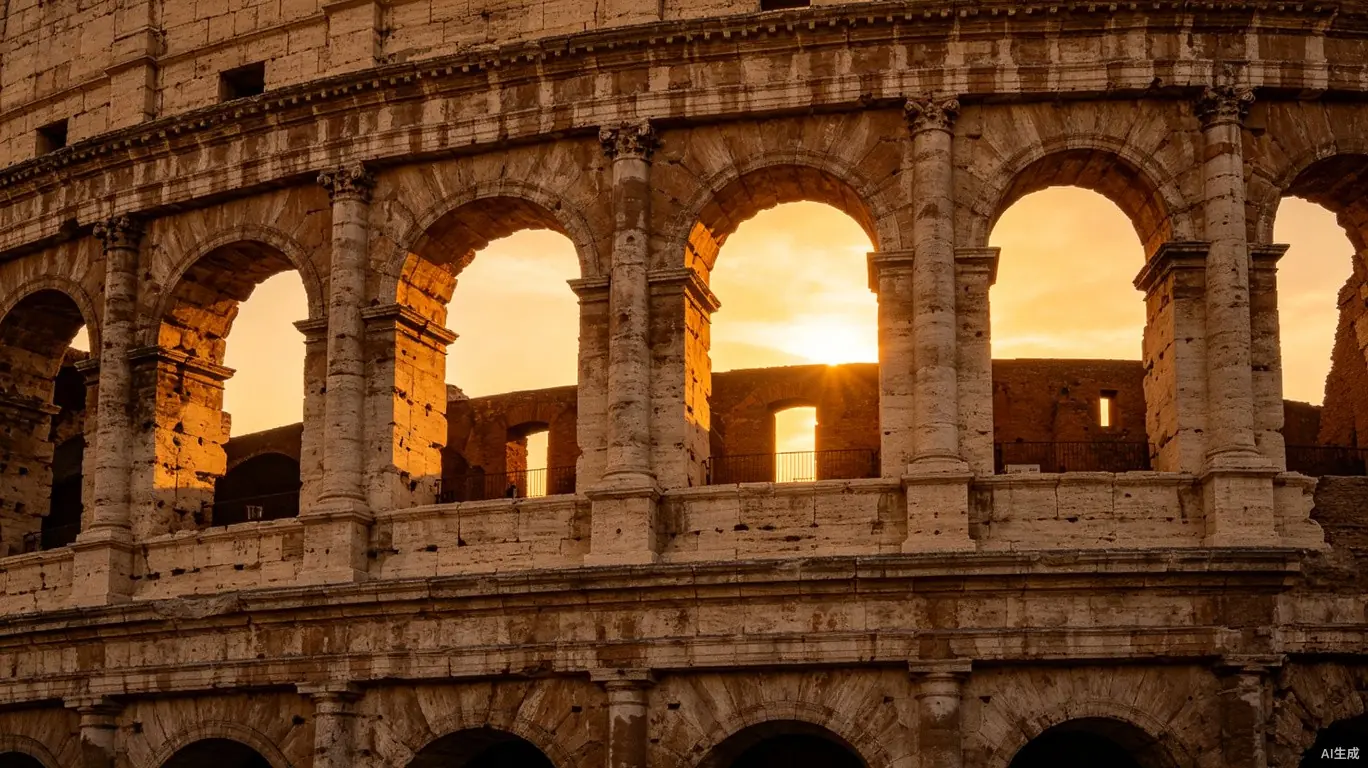
Ancient Rome was not just an empire of gladiators, emperors, and marble columns. Beneath the familiar stories lie incredible details about daily life, engineering marvels, and cultural practices that reveal a civilization far more complex and surprising than most people realize.
Daily Life and Society
1. Romans used a fermented fish sauce called garum on nearly everything. Made by fermenting fish intestines in salt for months, it was Rome's equivalent of ketchup, produced in massive factories along the Mediterranean.
2. Public toilets were social hubs -- stone seats side by side with no dividers, where Romans sat together chatting and doing business. A sponge on a stick soaked in vinegar served as communal toilet paper.
3. Rome had over one million people at its peak -- a number unmatched by any European city until 19th-century London. Supporting this required engineering feats impressive even by modern standards.
4. Slavery was pervasive, with slaves making up 30-40% of Italy's population. But Roman slavery was not race-based -- anyone could become a slave through war, debt, or birth, and freed slaves could become wealthy, influential citizens.
Engineering Marvels
5. Roman concrete was so advanced that structures built 2,000 years ago still stand while modern concrete crumbles in decades. Recent research found it contains quicklime clasts that self-heal cracks when exposed to water.
6. The Romans built over 400,000 kilometers of roads with multiple layers of stones, gravel, and cambered surfaces for drainage -- a design that remained the gold standard for two millennia.
7. Rome's aqueduct system delivered one million cubic meters of water daily through 11 major aqueducts spanning 500 km. Some, like the Aqua Virgo feeding the Trevi Fountain, still partially function today.
8. The Colosseum could be flooded to stage mock naval battles called naumachiae. Underground channels and sluice gates allowed enough water for actual ships with thousands of reenactors.
Politics and Power
9. Caligula's infamous reputation may be largely political propaganda. Many wild stories -- like appointing his horse as consul -- were written decades after his death to justify his assassination.
10. The Roman Republic's "dictator" was a constitutional emergency leader with absolute power for six months, expected to step down afterward. Most of them actually did.
11. Though excluded from voting and office, Roman women like Livia Drusilla wielded significant political power through influence. Her stepson Tiberius reportedly complained she wanted to be co-emperor.
12. The Western Empire didn't "fall" dramatically. The last emperor, a teenager named Romulus Augustulus, was deposed in 476 AD so quietly that most Romans barely noticed -- the Senate kept meeting.
Culture and Entertainment
13. Gladiatorial combat was rarely fatal. Gladiators were expensive investments like modern athletes, and skilled fighters became celebrities appearing on mosaics, lamps, and children's toys.
14. Rome had fast-food restaurants called thermopolia with street-front counters selling hot food. Over 150 have been found in Pompeii alone -- eating on the go is not modern.
15. Roman graffiti covered walls with political slogans, love declarations, and insults. One Pompeii example reads: "Epaphra, you are bald!" -- proving petty insults transcend millennia.
16. Saturnalia, celebrated around December 17th, inverted social norms: masters served slaves, gambling was permitted, and people exchanged gifts like candles and figurines -- traditions that influenced Christmas.
17. Roman military surgeons performed successful cataract surgeries, used opium as anesthesia, and sterilized instruments in boiling water centuries before germ theory was developed.
18. Rome's legacy extends beyond ruins. Latin became the Romance languages, Roman law forms European legal systems, and the Julian calendar -- 12 months and 365 days, refined by Caesar -- is the one we still use today.