
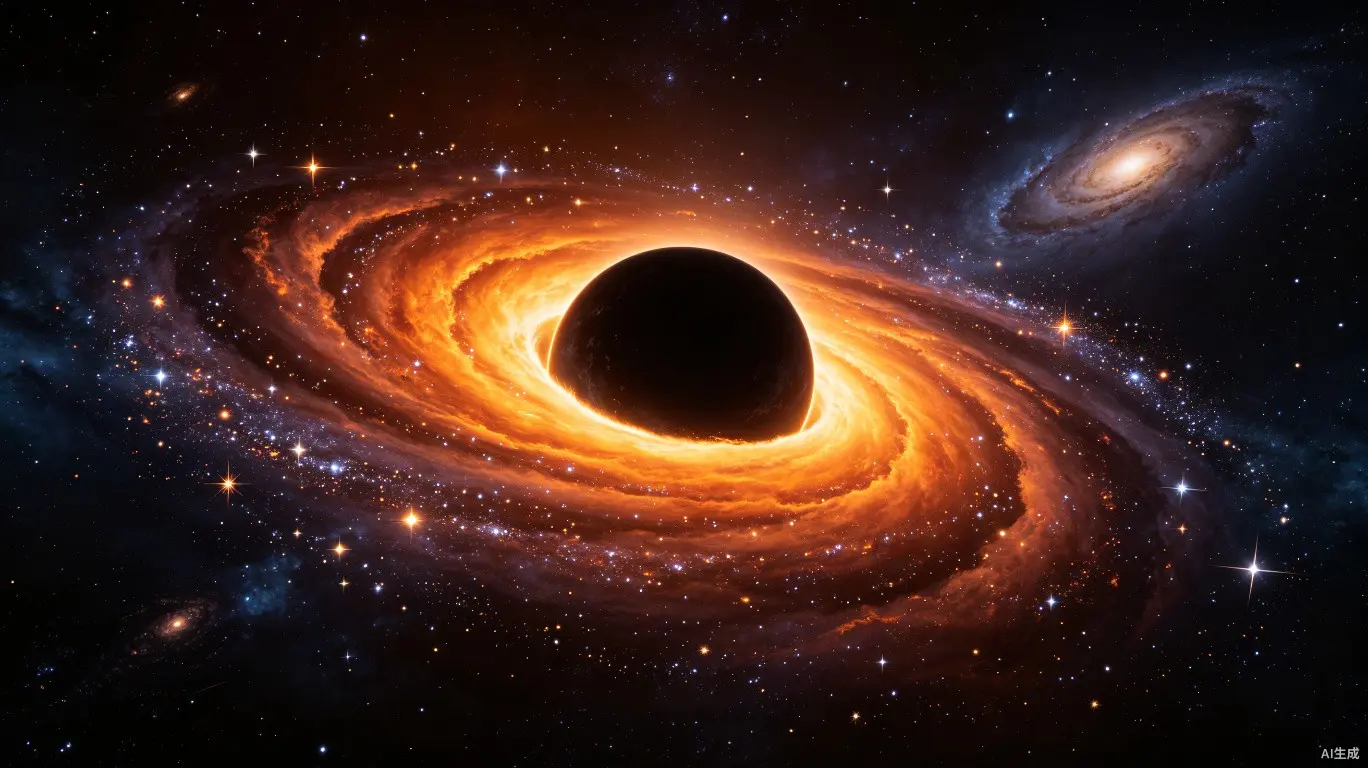
Black holes are among the most extreme and mysterious objects in the universe -- regions of spacetime where gravity is so strong that nothing, not even light, can escape. From supermassive giants at galactic centers to tiny primordial black holes, they challenge our understanding of physics and reality itself.
The Nature of Black Holes
1. A black hole forms when a massive star exhausts its nuclear fuel and collapses under its own gravity. If the remaining mass is more than about three times the mass of our Sun, no known force can stop the collapse, and a black hole is born.
2. The boundary of a black hole is called the event horizon -- the point of no return. Once anything crosses this threshold, it is forever trapped and can never escape. The event horizon is not a physical surface but a mathematical boundary.
3. At the center of a black hole lies the singularity, a point where density becomes infinite and the known laws of physics break down. Our current theories of gravity and quantum mechanics cannot describe what happens at the singularity, making it one of the greatest unsolved problems in theoretical physics.
4. Black holes come in different sizes. Stellar-mass black holes are 5 to 100 times the mass of the Sun. Supermassive black holes, found at the centers of most galaxies, can be millions or billions of solar masses. The largest known, TON 618, is estimated at 66 billion solar masses.
How We Detect Them
5. Black holes themselves are invisible, but we can observe their effects on surrounding matter. As gas and dust spiral into a black hole, they form an accretion disk that heats up to millions of degrees, emitting intense X-rays that telescopes can detect.
6. In 2019, the Event Horizon Telescope collaboration captured the first-ever image of a black hole, showing the shadow of the supermassive black hole at the center of galaxy M87. In 2022, they released an image of Sagittarius A*, the black hole at the center of our own Milky Way galaxy.
7. Gravitational waves -- ripples in spacetime predicted by Einstein -- were detected for the first time in 2015 from the merger of two black holes. Since then, the LIGO and Virgo observatories have detected dozens of black hole mergers, opening a new window on the universe.
Mind-Bending Effects
8. Time near a black hole slows down dramatically due to gravitational time dilation. If you could hover just above the event horizon and watch the outside universe, you would see stars evolve and die in what feels like moments to you.
9. Spaghettification is the process by which an object approaching a black hole would be stretched into a long, thin strand by extreme tidal forces. The difference in gravitational pull between your head and feet near a stellar-mass black hole would be enough to tear you apart atom by atom.
10. Stephen Hawking predicted that black holes aren't completely black -- they emit a faint radiation now called Hawking radiation. Over immense timescales, this radiation causes black holes to slowly evaporate. A black hole the mass of the Sun would take about 10^67 years to fully evaporate.
Cosmic Significance
11. Supermassive black holes play a crucial role in galaxy formation and evolution. The energy released by matter falling into these black holes can heat surrounding gas, regulate star formation, and even drive powerful galactic winds that shape the entire galaxy.
12. The mass of a supermassive black hole is closely correlated with the properties of its host galaxy's central bulge, even though the black hole contains only a tiny fraction of the galaxy's total mass. This suggests black holes and galaxies co-evolved through a deeply intertwined cosmic history.
13. Black holes may act as cosmic recycling engines. Material that falls into a black hole is not simply destroyed -- the energy released can seed new star formation in surrounding regions, creating a feedback loop that sustains galactic ecosystems over billions of years.
14. Quasars are among the brightest objects in the universe, powered by supermassive black holes actively feeding on surrounding matter. A single quasar can outshine its entire host galaxy of hundreds of billions of stars, and the most distant quasars we observe existed when the universe was less than a billion years old.
Frontier Questions
15. The black hole information paradox asks: what happens to information about matter that falls into a black hole? Quantum mechanics says information cannot be destroyed, but general relativity suggests it is lost forever. Resolving this paradox could lead to a theory of quantum gravity.
16. Wormholes, theoretical tunnels through spacetime connecting two distant points, are mathematically permitted by general relativity but would require exotic matter with negative energy density to remain open. Some physicists speculate that black holes might be gateways to other universes.
17. Primordial black holes, hypothesized to have formed in the earliest moments after the Big Bang, could range in size from subatomic to thousands of solar masses. If they exist, they might account for some or all of the mysterious dark matter that pervades the universe.
18. The study of black holes has driven some of the most profound advances in theoretical physics, from Hawking's discovery of black hole radiation to the holographic principle, which suggests our three-dimensional universe might be encoded on a two-dimensional surface -- an idea inspired by black hole thermodynamics.