
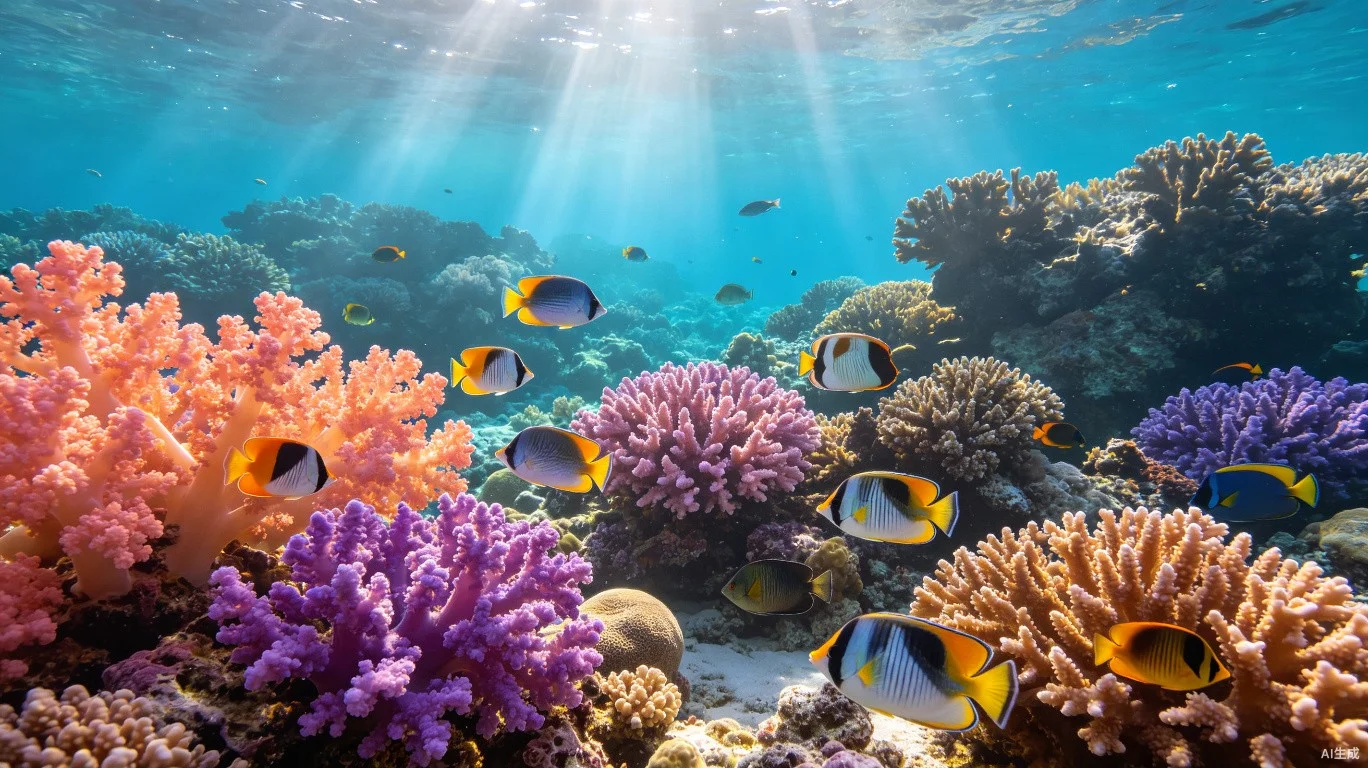
Coral reefs are among the most biodiverse and spectacular ecosystems on Earth, covering less than 1% of the ocean floor yet supporting nearly 25% of all marine life. These underwater cities teem with color, complexity, and secrets scientists are still uncovering.
The Living Architecture
1. Coral reefs are built by tiny animals called coral polyps, each about the size of a grain of rice. These soft-bodied creatures secrete calcium carbonate skeletons beneath themselves, which accumulate over thousands of years to form massive reef structures. The Great Barrier Reef alone is composed of roughly 400 billion coral polyps.
2. Corals have a remarkable partnership with microscopic algae called zooxanthellae, which live inside the polyps' tissues. The algae photosynthesize, providing up to 90% of the coral's energy, while the coral provides the algae with shelter and carbon dioxide. This symbiosis is what gives corals their vivid colors.
3. Coral reefs can live for thousands of years. Some individual coral colonies, like certain massive Porites corals, are over 1,000 years old. The reef structure itself -- built by countless generations of corals -- can be over 50 million years old, as evidenced by ancient fossilized reefs.
Extraordinary Biodiversity
4. The Great Barrier Reef is the world's largest living structure, stretching over 2,300 kilometers along Australia's northeast coast. It is so large it can be seen from space and contains over 2,900 individual reefs. It supports more than 1,500 species of fish, 400 types of coral, and 4,000 species of mollusk.
5. The Coral Triangle, encompassing waters around Indonesia, the Philippines, and Papua New Guinea, is the most biodiverse marine region on Earth. This area contains 76% of all known coral species and supports over 3,000 fish species. It has been called the "Amazon of the Seas" for its extraordinary richness.
6. Deep-sea coral reefs exist at depths exceeding 2,000 meters where no sunlight penetrates. Unlike their shallow-water relatives, deep-sea corals do not rely on symbiotic algae but instead capture passing food particles from ocean currents. Some deep-sea coral colonies are over 4,000 years old, making them among the oldest living organisms on Earth.
Incredible Adaptations
7. Some corals are fluorescent -- they produce their own light through fluorescent proteins that absorb blue light and re-emit it as green, red, or orange. Scientists believe this fluorescence may serve as a natural sunscreen, protecting the corals and their algal partners from excessive solar radiation in shallow waters.
8. Corals have a remarkable ability to clone themselves. When a coral colony is broken apart by storms, each fragment can grow into a new, genetically identical colony. Coral restoration projects exploit this natural ability, growing coral fragments in nurseries and transplanting them onto damaged reefs.
9. Coral spawning is one of nature's most spectacular synchronized events. On certain nights following a full moon in late spring, entire reef systems release billions of eggs and sperm simultaneously into the water. The spawning is precisely timed to water temperature and lunar cycles, ensuring maximum fertilization success.
Threats and Resilience
10. Coral bleaching occurs when stressed corals expel their symbiotic algae, turning ghostly white. While bleached corals are not dead, they are starving and extremely vulnerable. Prolonged bleaching events, driven by rising ocean temperatures, killed roughly 14% of the world's coral between 2009 and 2018.
11. The 2023-2024 global coral bleaching event was the most widespread on record, affecting reefs in over 65 countries across the Atlantic, Pacific, and Indian Oceans. Scientists confirmed it as the fourth global bleaching event in history, following events in 1998, 2010, and 2014-2017.
12. Some corals have shown remarkable resilience by evolving heat-tolerant traits. Scientists have discovered "super corals" in the Red Sea and Persian Gulf that withstand temperatures 2-3 degrees Celsius above normal bleaching thresholds. Researchers are studying these resilient populations to develop assisted evolution strategies for threatened reefs.
Hidden Chemistry
13. Coral reefs produce more chemical compounds than almost any other ecosystem. These compounds serve as natural defenses against predators, competitors, and disease. Many have found their way into human medicine, including compounds for treating cancer, HIV, inflammation, and bacterial infections.
14. A compound called bryostatin, originally isolated from a coral reef organism known as Bugula neritina, showed remarkable potential in treating Alzheimer's disease in early clinical trials. The compound appears to stimulate the growth of new neural connections and enhance memory function in animal models.
15. Coral skeletons have been used for bone grafts in human surgery since the 1970s. The porous, calcium-carbonate structure of certain corals is remarkably similar to human bone, allowing blood vessels and bone cells to grow into and through the coral implant, which is gradually replaced by natural bone.
Cultural and Economic Value
16. Coral reefs support the livelihoods of over 500 million people worldwide through fishing, tourism, and coastal protection. The global economic value of coral reefs is estimated at $375 billion annually. Reefs act as natural breakwaters, reducing wave energy by up to 97% and protecting coastal communities from storms.
17. Indigenous communities in the Pacific Islands and Australia have managed coral reef resources sustainably for thousands of years. Traditional practices include temporary fishing closures, sacred marine areas, and species-specific harvesting rules that have proven remarkably effective at maintaining reef health.
18. Scientists are now using artificial intelligence and underwater drones to map and monitor coral reefs at unprecedented scales. The Allen Coral Atlas, completed in 2021, provides the first high-resolution map of all the world's shallow coral reefs, enabling conservationists to track changes in reef health in near real-time from space.