
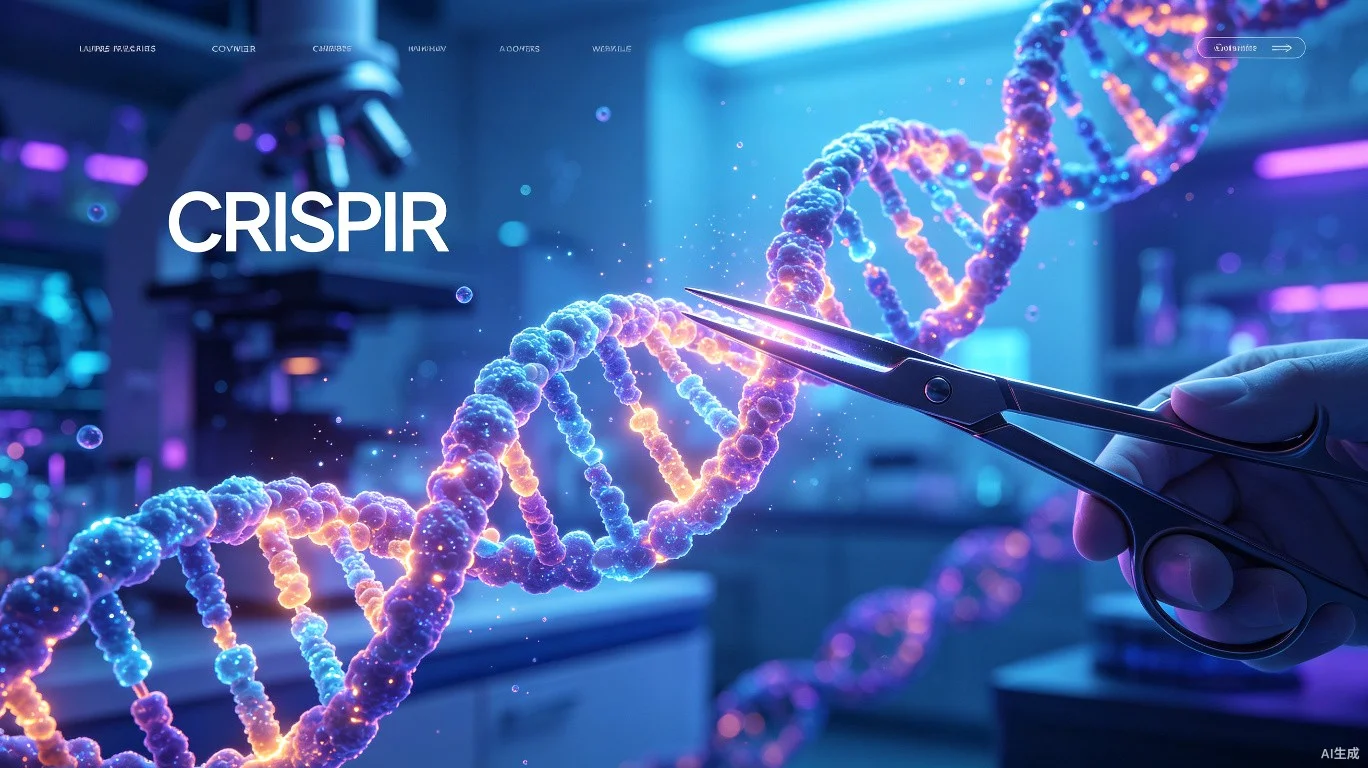
CRISPR technology has unleashed a revolution in genetic engineering, promising cures for genetic diseases, climate-resistant crops, and even the power to reshape evolution itself. What began as a bacterial defense mechanism is now the most powerful gene-editing tool ever discovered.
The Discovery and Mechanism
1. CRISPR (Clustered Regularly Interspaced Short Palindromic Repeats) was first discovered in 1987 by Japanese scientist Yoshizumi Ishino, but its function as a bacterial immune system was not understood until 2007. Bacteria use CRISPR to store snippets of viral DNA, which they later use to recognize and destroy invading viruses.
2. The CRISPR-Cas9 system works like molecular scissors guided by GPS. The Cas9 protein is directed by a guide RNA to a specific DNA sequence, where it makes a precise double-strand cut. The cell's natural repair machinery then kicks in, allowing scientists to delete, insert, or modify genes at the cut site.
3. Jennifer Doudna and Emmanuelle Charpentier won the 2020 Nobel Prize in Chemistry for developing the CRISPR-Cas9 gene-editing tool. Their landmark 2012 paper demonstrated how the bacterial system could be reprogrammed to cut any DNA sequence, launching the gene-editing revolution.
Medical Breakthroughs
4. In 2023, the FDA approved Casgevy, the first CRISPR-based therapy, for treating sickle cell disease and beta-thalassemia. The treatment edits a patient's own blood stem cells to produce fetal hemoglobin, effectively curing the disease. Over 90% of treated patients remain symptom-free years after a single treatment.
5. Clinical trials using CRISPR to treat inherited blindness have restored vision in several patients. In 2024, researchers at Oregon Health & Science University reported that a single CRISPR injection into the eye restored meaningful vision in patients with Leber congenital amaurosis, a form of blindness caused by a mutation in the CEP290 gene.
6. CRISPR is being explored as a potential cure for HIV. Researchers have used the technology to cut HIV DNA out of infected human cells in laboratory experiments. In 2024, Temple University scientists successfully eliminated HIV from humanized mice using a combination of CRISPR and long-acting antiretroviral therapy.
7. Cancer immunotherapy has been revolutionized by CRISPR. Scientists can now edit T-cells to better recognize and attack cancer cells. CAR-T cell therapies enhanced with CRISPR gene editing have shown remarkable results in clinical trials for blood cancers, with some patients achieving complete remission after exhausting all other options.
Agricultural Applications
8. CRISPR-edited crops are already on the market. In Japan, CRISPR-edited tomatoes with higher GABA content (which may lower blood pressure) have been sold to consumers since 2021. Unlike traditional GMOs, many CRISPR-edited crops contain no foreign DNA and are regulated more lightly in countries like the US and Japan.
9. Scientists have used CRISPR to create wheat varieties resistant to powdery mildew, a devastating fungal disease that can destroy up to 40% of global wheat harvests. The edited wheat requires no fungicide treatment and could dramatically reduce agricultural chemical use while improving food security.
10. Researchers are using CRISPR to develop climate-resilient crops: rice that can survive flooding for weeks, corn that maintains yield during drought, and soybeans with enhanced heat tolerance. These innovations could be critical for feeding a growing global population as climate change intensifies.
Ethical Frontiers
11. In 2018, Chinese scientist He Jiankui announced the birth of twin girls whose embryos he had edited using CRISPR to confer resistance to HIV. The experiment was universally condemned by the scientific community as premature and unethical, and He was sentenced to three years in prison. The incident sparked urgent global discussions about the ethics of human germline editing.
12. The World Health Organization established a global registry for human genome editing research in 2019 and issued comprehensive governance recommendations in 2021. The framework calls for strict oversight, public engagement, and international cooperation before any clinical applications of heritable human genome editing can be considered.
13. Gene drives, which use CRISPR to spread genetic modifications through entire wild populations, could eliminate malaria by making mosquitoes unable to carry the parasite. However, releasing a gene drive into the wild raises profound ecological and ethical questions about intentionally altering or potentially driving species to extinction.
Advanced Technologies
14. Base editing, a more precise form of CRISPR developed by David Liu's lab, can change a single DNA letter (A, T, C, or G) without cutting both strands of the DNA helix. This dramatically reduces the risk of unintended mutations and is being tested for treating progeria, a fatal premature aging disease caused by a single letter mutation.
15. Prime editing, described as a "search and replace" function for DNA, can insert, delete, or replace DNA sequences with unprecedented precision. Published in 2019, prime editing can theoretically correct about 89% of known disease-causing genetic mutations, making it one of the most versatile gene-editing tools ever created.
16. CRISPR diagnostics have emerged as a powerful new application. SHERLOCK and DETECTR platforms use CRISPR to detect specific genetic sequences from viruses, bacteria, or cancer mutations with remarkable sensitivity. During the COVID-19 pandemic, CRISPR-based tests provided results in under 30 minutes without requiring laboratory equipment.
The Future
17. Scientists are exploring CRISPR as a tool for de-extinction -- bringing back species like the woolly mammoth by editing elephant DNA. Colossal Biosciences has raised over $225 million to create a cold-resistant elephant-mammoth hybrid, with the goal of restoring Arctic grasslands and combating climate change.
18. The global CRISPR market is projected to exceed $15 billion by 2030, driven by therapeutic applications, agricultural innovations, and diagnostic tools. As delivery methods improve and more diseases become treatable, CRISPR is poised to become one of the most transformative technologies of the 21st century.