
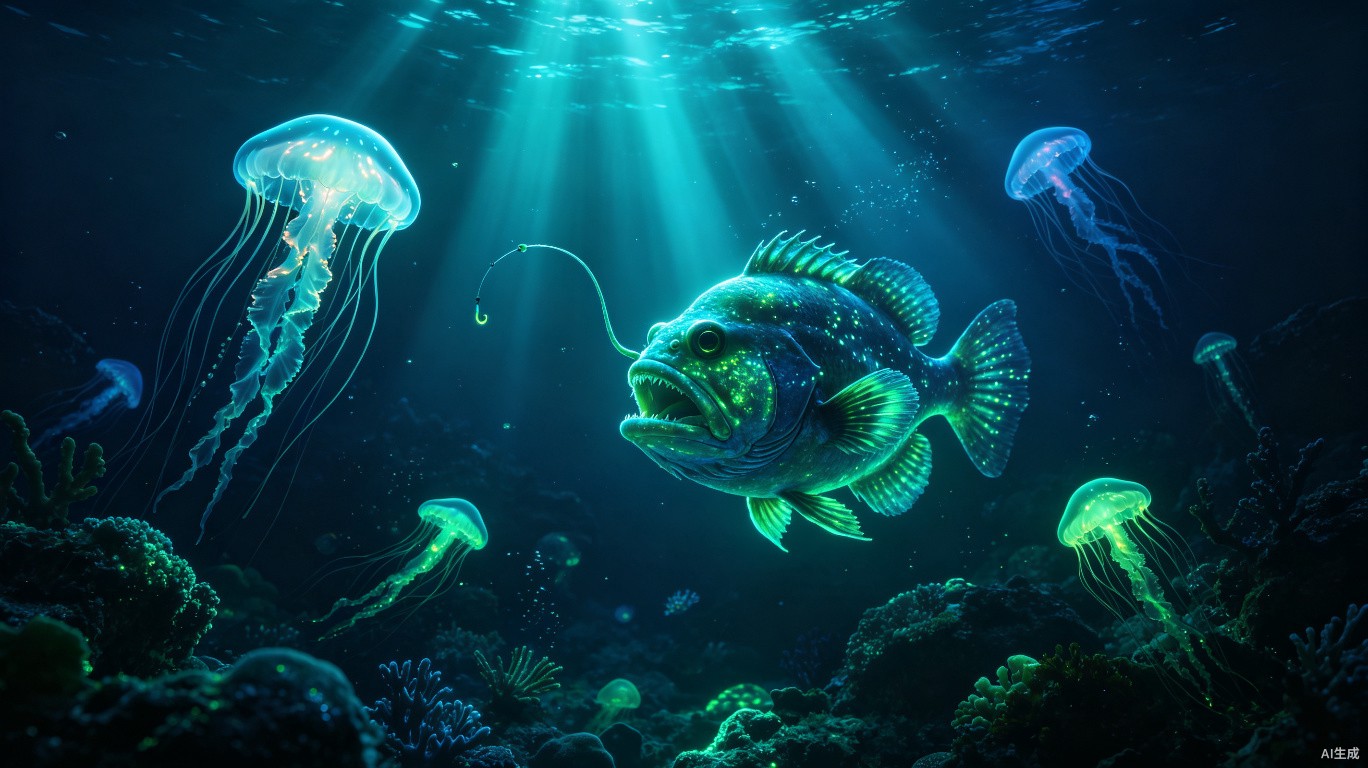
The deep sea is Earth''s largest habitat, covering more than 60% of the planet''s surface, yet we know less about it than the surface of Mars. In its crushing darkness, evolution has produced creatures so bizarre they seem like aliens from another world.
Life in Extreme Depths
1. The deep sea begins at around 200 meters, where sunlight can no longer penetrate -- a zone called the twilight zone. Below 1,000 meters lies the midnight zone, where the ocean is in perpetual darkness and temperatures hover just above freezing.
2. The pressure at the bottom of the Mariana Trench is over 1,000 times standard atmospheric pressure -- equivalent to having 50 jumbo jets stacked on top of you. Yet life thrives there, thanks to specialized cellular adaptations.
3. Deep-sea gigantism is a real phenomenon where certain deep-sea creatures grow far larger than their shallow-water relatives. The giant isopod can reach 36 centimeters, and the giant squid can grow up to 13 meters long.
4. Some deep-sea creatures don''t rely on the sun at all. Entire ecosystems around hydrothermal vents are powered by chemosynthesis, where bacteria convert hydrogen sulfide and methane from the vents into energy.
Bizarre Adaptations
5. Bioluminescence is the most common form of communication in the deep sea. Over 90% of deep-sea creatures produce their own light, using it to attract prey, confuse predators, or find mates in the eternal darkness.
6. The anglerfish''s glowing lure is actually a modified dorsal spine packed with bioluminescent bacteria. The female anglerfish can be up to 60 times larger than the male, who permanently fuses to her body as a parasite.
7. The barreleye fish has a transparent, fluid-filled dome on its head through which its tubular eyes can rotate. It can look straight up through its own transparent skull to spot the silhouettes of prey above.
8. The vampire squid has the largest eyes relative to body size of any animal. When threatened, it inverts its cape-like webbing to reveal glowing spines, a display so dramatic it earned the creature its name.
9. The glass squid has evolved near-perfect transparency, making it almost invisible in the water column. Its only visible parts are its eyes and digestive gland, which are mounted on stalks to cast the smallest possible shadow.
Survival Strategies
10. Many deep-sea fish have enormous, hinged jaws and expandable stomachs that allow them to swallow prey larger than themselves. The black swallower can consume fish up to 10 times its own mass.
11. The tripod fish stands on three elongated fin rays like a tripod on the sea floor, facing into the current. It waits motionless for hours, sensing prey with modified fins that act like hands.
12. Deep-sea gigantism isn''t universal -- there is also deep-sea dwarfism, where scarcity of food drives smaller body sizes. The dwarf lanternshark is the smallest shark in the world, reaching only 20 centimeters in length.
13. The yeti crab farms bacteria on its hairy claws, which give the crab its name. It waves its claws over hydrothermal vent fluids to feed its bacterial garden, then scrapes off and eats the grown microbes.
Discovery and Mystery
14. Scientists estimate that up to 91% of ocean species remain undiscovered. Most of these unknown species live in the deep sea, meaning there are potentially millions of creatures we have never seen.
15. The giant squid was considered a mythological creature until 2004, when Japanese researchers captured the first live images. In 2012, a team filmed a giant squid in its natural deep-sea habitat for the first time.
16. Deep-sea coral reefs can live for over 4,000 years, making them some of the oldest living organisms on Earth. Unlike tropical corals, they feed on drifting particles rather than sunlight-dependent algae.
17. Xenophyophores -- giant single-celled organisms that can reach 20 centimeters across -- inhabit the deepest trenches. They build intricate skeletons by cementing together sediment particles, creating fragile structures on the abyssal plain.
18. The Mariana snailfish, the deepest-living fish ever recorded at 8,178 meters, survives by producing a special chemical called trimethylamine N-oxide that prevents proteins from being crushed by the immense pressure.