
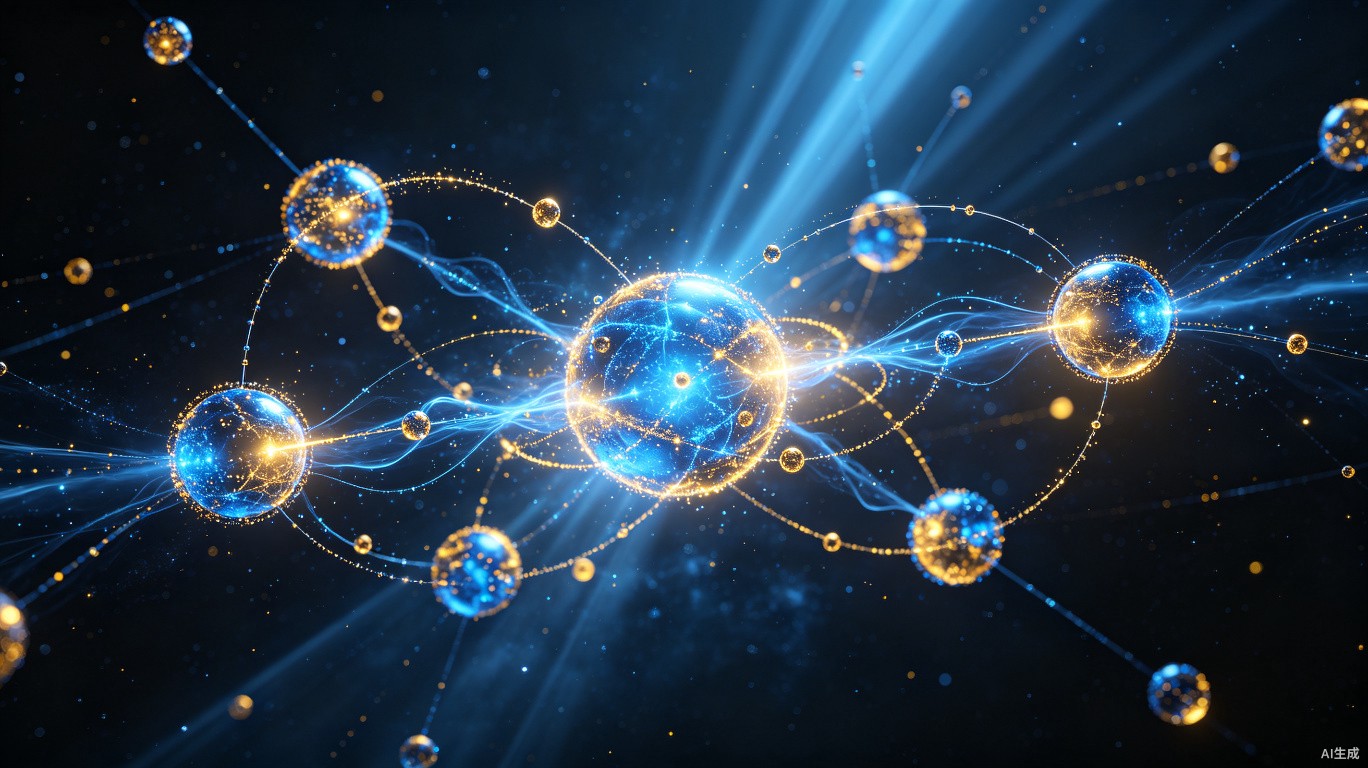
Quantum entanglement is one of the most bizarre and mind-bending phenomena in modern physics. Einstein called it "spooky action at a distance," and its implications challenge everything we think we know about reality, locality, and the nature of information itself.
The Basics of Entanglement
1. Quantum entanglement occurs when two or more particles become linked in such a way that the quantum state of each particle cannot be described independently. Measuring one instantly determines the state of the other, no matter how far apart they are.
2. Entanglement was first described in a 1935 paper by Einstein, Podolsky, and Rosen -- known as the EPR paradox. They proposed it as an argument against the completeness of quantum mechanics, believing it showed the theory must be missing hidden variables.
3. The term "entanglement" was coined by Erwin Schrodinger in 1935. He considered it the defining feature of quantum mechanics, writing that entanglement is "not one but rather the characteristic trait of quantum mechanics."
4. Entangled particles do not actually "communicate" faster than light. While the correlation appears instantaneous, no usable information can be transmitted this way, which means special relativity is not violated.
Experiments and Evidence
5. John Bell's theorem, published in 1964, provided a way to experimentally distinguish between quantum mechanics and any local hidden variable theory. Bell showed that if hidden variables existed, the statistical correlations between measurements would have a strict upper limit.
6. The first conclusive Bell test was performed by Alain Aspect in 1982. His experiment used entangled photons and rapidly switching detectors, ruling out the possibility that the particles were communicating through any local mechanism.
7. In 2017, Chinese scientists achieved entanglement-based quantum communication between a satellite and ground stations over a record distance of 1,200 kilometers. The Micius satellite successfully distributed entangled photon pairs between two ground stations.
8. Entanglement has been demonstrated not just with photons, but with atoms, molecules, superconducting circuits, and even tiny mechanical oscillators visible to the naked eye -- pushing the boundary between quantum and classical worlds.
Applications and Implications
9. Quantum teleportation uses entanglement to transfer a quantum state from one particle to another without the particle itself traveling through the intervening space. The first quantum teleportation was demonstrated in 1997.
10. Quantum cryptography relies on entanglement to create theoretically unbreakable encryption. Any attempt to eavesdrop on an entangled communication channel inevitably disturbs the quantum state, alerting the communicating parties.
11. Quantum computers harness entanglement to perform certain calculations exponentially faster than classical computers. A fully operational large-scale quantum computer could break current encryption methods and revolutionize drug discovery.
12. Entanglement may play a role in biological processes. Some researchers propose that quantum coherence and entanglement help explain the extraordinary efficiency of photosynthesis in plants and the magnetic navigation of birds.
Deep Mysteries
13. The "measurement problem" remains unsolved: we do not fully understand how or why observing a quantum system causes its wave function to collapse, breaking the entanglement in the process.
14. Entanglement suggests that at a fundamental level, space and distance may not be as real as we perceive them to be. Some physicists argue that entanglement implies reality is non-local -- meaning everything in the universe is fundamentally interconnected.
15. The ER=EPR conjecture, proposed by Leonard Susskind and Juan Maldacena, suggests that entanglement and wormholes (Einstein-Rosen bridges) are fundamentally the same phenomenon -- two entangled particles are connected by a microscopic wormhole.
16. Entanglement entropy could explain the arrow of time. As particles become increasingly entangled with their environment, the total entanglement grows, providing a possible quantum origin for the one-way flow of time we experience.
17. Quantum entanglement may be the key to unifying quantum mechanics with general relativity. If spacetime itself emerges from the entanglement of underlying quantum degrees of freedom, entanglement would be the fundamental fabric of the cosmos.
18. Despite being verified in countless experiments, physicists still debate what entanglement actually means philosophically. Does it imply a deeply interconnected universe where separateness is an illusion, or is it simply a feature of the mathematics with no deeper significance?