
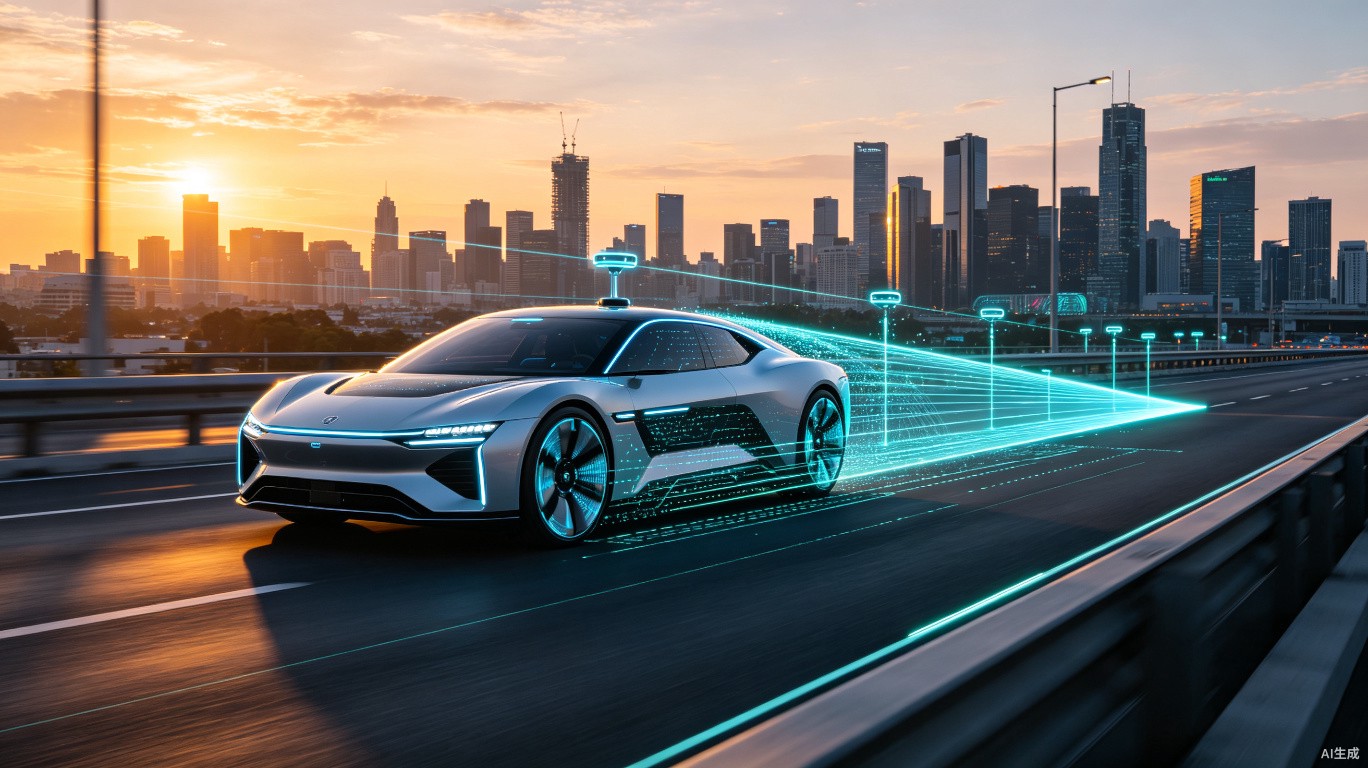
Self-driving cars have moved from science fiction to reality faster than almost anyone predicted. Behind the promise of safer roads and transformed cities lies a fascinating story of artificial intelligence, sensor technology, and some of the hardest engineering challenges ever attempted.
The Evolution of Autonomy
1. The first truly autonomous vehicle was developed in 1986 by Ernst Dickmanns at the Bundeswehr University in Munich. His modified Mercedes van, called VaMoRs, could drive at speeds up to 96 km/h on empty roads using computer vision.
2. The DARPA Grand Challenge in 2004 offered a $1 million prize for an autonomous vehicle to complete a 240 km desert course. Not a single vehicle finished -- the best managed only 11 km. The next year, five vehicles completed the course.
3. Waymo (formerly the Google Self-Driving Car Project) has accumulated over 20 million miles of real-world autonomous driving and billions more in simulation -- equivalent to hundreds of human lifetimes behind the wheel.
4. The Society of Automotive Engineers defines six levels of driving automation, from Level 0 (no automation) to Level 5 (full automation in all conditions). Most commercially available systems today operate at Level 2 or Level 3.
How They See the World
5. A typical self-driving car carries an array of sensors including LIDAR (Light Detection and Ranging), radar, ultrasonic sensors, and multiple high-definition cameras. LIDAR alone generates about 1.3 million data points per second to build a 3D map of the environment.
6. The LIDAR units on early prototypes cost over $75,000 each, more than the vehicle itself. Advances in solid-state LIDAR technology have since brought the cost below $500, making mass production feasible.
7. Self-driving cars can see in the dark better than humans can. Radar penetrates rain and fog, LIDAR operates independently of lighting conditions, and infrared cameras detect pedestrians and animals that headlights would miss.
8. Autonomous vehicles don''t just react to what they see -- they predict. Their AI models are trained on millions of traffic scenarios to anticipate what other drivers, cyclists, and pedestrians are likely to do several seconds into the future.
Safety and Challenges
9. Human error causes approximately 94% of all traffic accidents. Autonomous vehicles never get tired, distracted, or intoxicated, and they can react in milliseconds -- about 10 times faster than the average human driver.
10. The "trolley problem" -- a classic ethical dilemma about choosing whom to harm in an unavoidable crash -- remains one of the most debated aspects of autonomous vehicle programming. Different cultures have fundamentally different expectations about whom the car should prioritize.
11. Bad weather remains a significant challenge for self-driving cars. Heavy snow can block sensors, obscure lane markings, and confuse the vehicle''s understanding of its position. Many autonomous fleets still suspend operations during severe storms.
12. Self-driving cars have already been involved in fatal accidents, including a widely publicized 2018 Uber crash in Arizona. These incidents have sparked debates about regulation, liability, and whether autonomous systems should be held to a higher safety standard than human drivers.
The Road Ahead
13. Self-driving taxis are already operating commercially in several cities including San Francisco, Phoenix, and Wuhan, China. The world''s largest autonomous ride-hailing fleet, operated by Baidu''s Apollo Go, completed over 1 million rides in 2025 alone.
14. Autonomous trucks could transform the logistics industry. Long-haul trucking is particularly suited to automation because highways are more predictable than city streets, and driver fatigue is a leading cause of truck accidents.
15. Vehicle-to-vehicle communication (V2V) would allow self-driving cars to coordinate with each other, sharing data about road conditions, hazards, and traffic patterns. A fully V2V-enabled fleet could safely travel at much higher speeds and with much closer spacing.
16. The economic impact of autonomous vehicles could be enormous. Some estimates suggest they could add $1.5 trillion annually to the U.S. economy through increased productivity, reduced accident costs, and new mobility services.
17. Fully autonomous vehicles may dramatically reshape cities. Parking lots could become parks, traffic lights might become obsolete, and the concept of personal car ownership could give way to on-demand autonomous fleets.
18. Despite rapid progress, experts remain divided on when Level 5 autonomy will arrive. Optimists predict within 5 years; skeptics argue that true driverless capability in all conditions may be decades away due to the virtually infinite edge cases that exist on real roads.