
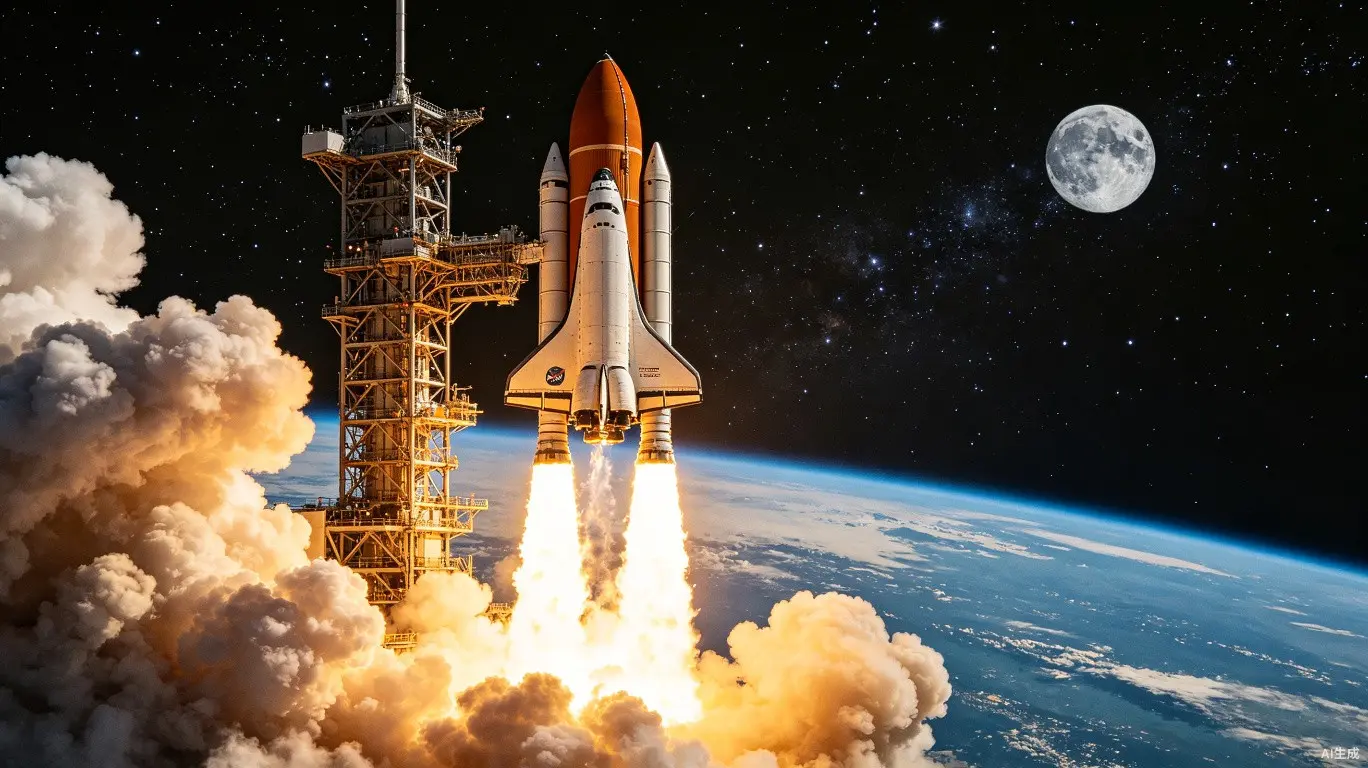
The Space Race between the United States and the Soviet Union was one of the defining dramas of the 20th century -- a high-stakes technological competition fueled by Cold War rivalry, national pride, and humanity's deepest desire to explore the unknown. The astonishing story is filled with triumph, tragedy, and secrets that remained classified for decades.
Origins and Early Milestones
1. The Space Race officially began on October 4, 1957, when the Soviet Union launched Sputnik 1, the world's first artificial satellite. The beach-ball-sized sphere weighed just 83.6 kilograms and transmitted a simple radio beep, but its psychological impact on the United States was seismic -- triggering a national crisis over perceived technological inferiority.
2. The Soviet Union's early lead was built largely on the work of captured German rocket scientists after World War II. However, the U.S. captured the more senior German team, including Wernher von Braun, who had designed the V-2 rocket. Von Braun would later become the architect of the Saturn V moon rocket.
3. Before humans ever flew, both nations sent animals into space. The Soviets launched Laika the dog aboard Sputnik 2 in November 1957, making her the first living creature to orbit Earth. Tragically, Laika died within hours from overheating and stress -- a fate the Soviet Union concealed for 45 years, initially claiming she had been euthanized humanely.
4. Yuri Gagarin became the first human in space on April 12, 1961, orbiting Earth once aboard Vostok 1 in a flight lasting 108 minutes. His famous words at launch -- "Poyekhali!" meaning "Let's go!" -- became an iconic phrase of the era. Gagarin's selection was partly due to his modest height of 157 centimeters, ideal for the cramped Vostok capsule.
The Race to the Moon
5. President John F. Kennedy's famous 1961 speech before Congress -- committing the U.S. to land a man on the Moon before the decade ended -- was initially opposed by many of his own advisors. NASA administrator James Webb privately estimated the cost at over $20 billion (equivalent to roughly $200 billion today), a staggering sum for a single project.
6. The Apollo program employed over 400,000 people at its peak, spanning 20,000 industrial firms and universities. At one point, an estimated one in every 175 Americans was working in some capacity to put astronauts on the Moon -- making it the largest peacetime engineering project in human history.
7. The Soviet Union's secret moon program, known as the N1-L3, was plagued by disaster. All four test launches of the N1 rocket -- the Soviet equivalent of the Saturn V -- ended in catastrophic failure, including one explosion that was one of the largest non-nuclear detonations in history, equivalent to nearly 7 kilotons of TNT.
8. Apollo 11's landing was far more precarious than the smooth television broadcast suggested. Neil Armstrong had to take manual control and fly the lunar module over a boulder field with only 25 seconds of fuel remaining when he finally touched down. The low-fuel warning light had been illuminated for nearly a minute before landing.
Hidden Stories and Cold War Secrets
9. The Apollo 11 astronauts left behind a silicon disc containing goodwill messages from 73 world leaders on the Moon's surface. Notably absent was any message from the Soviet Union, which refused to participate. The disc, smaller than a 50-cent piece, remains on the Moon in the Sea of Tranquility to this day.
10. A secret U.S. military program, Project Horizon, proposed building a manned military outpost on the Moon by 1966, complete with nuclear weapons aimed at Earth. The plan, declassified in 2014, was ultimately rejected as impractical and unnecessarily provocative, but it underscores how deeply the Moon was viewed through a military lens.
11. The Soviet Union landed the first robotic rover on the Moon -- Lunokhod 1 -- in 1970, a full year before Apollo 15 astronauts drove the Lunar Roving Vehicle. Lunokhod 1 traveled 10.5 kilometers over 11 months, surviving freezing lunar nights with a radioisotope heater powered by polonium-210.
12. During the Apollo 13 crisis, the Soviet Union voluntarily shut down radio transmissions on frequencies used by the crippled spacecraft and diverted ships toward the planned splashdown zone in case rescue was needed. This quiet act of Cold War solidarity was largely unknown until decades later.
Legacy and Revival
13. The total cost of the Apollo program was $25.4 billion -- about $257 billion in 2026 dollars. For perspective, that is roughly three times the cost of the Manhattan Project and equivalent to the total U.S. federal budget for 1969. The program consumed over 4% of the federal budget at its peak.
14. The Apollo program generated over 6,300 technology patents, many of which found everyday applications. Memory foam, cordless power tools, freeze-dried food, fire-resistant fabrics, and the computer microchip all trace their commercial development directly to space program investments.
15. Between 1972 and 2024, no human being ventured beyond low Earth orbit -- a 52-year gap in deep space exploration. This changed with the successful launch of Artemis II in late 2025, which carried four astronauts around the Moon, including the first woman and first person of color to travel beyond Earth orbit.
16. The Soviet Buran space shuttle, designed to rival the American Space Shuttle, flew only once -- an entirely unmanned, autonomous mission in 1988 that completed two orbits and landed perfectly on a runway. The program was canceled after the Soviet Union's collapse, and the sole flight-worthy Buran was destroyed in 2002 when its hangar collapsed.
New Competitors
17. China became the third nation to independently send humans into space in 2003, and by 2026 it has established its own permanently crewed space station, Tiangong, and successfully landed rovers on both the Moon and Mars. China's ambitious timeline targets a crewed lunar landing by 2030, potentially marking the beginning of a new space race.
18. Private companies have fundamentally transformed space exploration economics. SpaceX's Starship achieved the first fully reusable heavy-lift capability in 2025, reducing launch costs by over 90% compared to traditional rockets. The cost to send one kilogram to orbit has fallen from roughly $54,000 (Space Shuttle era) to under $1,500, opening space to unprecedented commercial and scientific activity.