
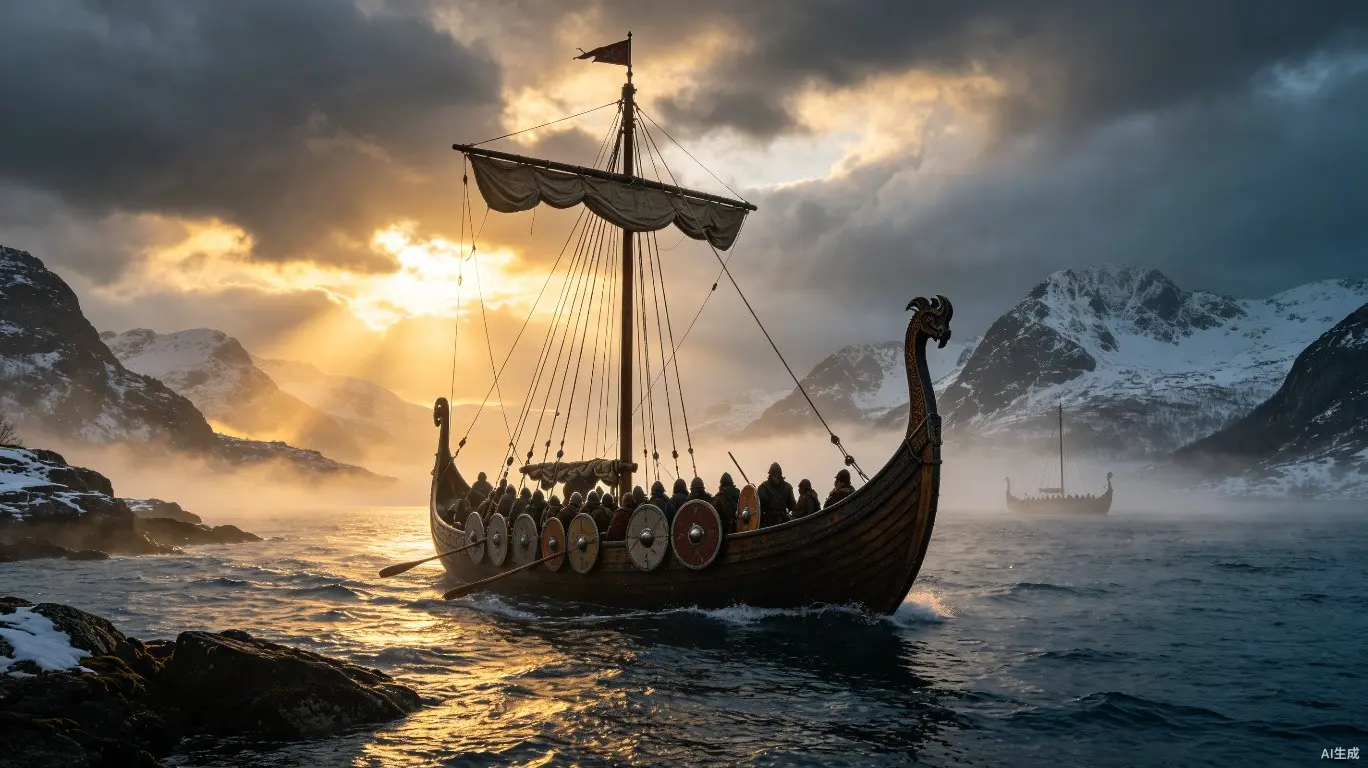
The Viking Age (roughly 793-1066 AD) was far more than a period of raiding and pillaging. The Norse people were extraordinary explorers, traders, artisans, and settlers who established trade networks stretching from Baghdad to North America, and their influence shaped the medieval world in profound and lasting ways.
Explorers and Discoverers
1. The Vikings reached North America approximately 500 years before Christopher Columbus. Around the year 1000, Leif Erikson established a settlement at L'Anse aux Meadows in present-day Newfoundland, Canada, confirmed by archaeological excavations in the 1960s.
2. Viking traders and mercenaries traveled as far east as Baghdad, serving as the Varangian Guard for the Byzantine Emperor in Constantinople. Runic graffiti carved by Vikings can still be seen in the Hagia Sophia, one of the greatest monuments of the Byzantine Empire.
3. The Vikings settled Iceland around 874 AD, and within 60 years, the island had a population of over 60,000. Iceland's Althing, established in 930 AD, is the world's oldest surviving parliament, and the country's detailed legal codes were preserved orally for centuries before being written down.
Society and Culture
4. Viking women had significantly more rights than women in most other medieval European societies. They could own property, initiate divorce, reclaim their dowry if the marriage ended, and participate in trade. Some high-status women were even buried with weapons and scales, suggesting roles as warriors or merchants.
5. The Vikings had an elaborate oral literary tradition that preserved their history and mythology. The Norse sagas, written down in Iceland during the 13th century, remain among the most detailed records we have of medieval Scandinavian society, combining history, genealogy, and myth into compelling narratives.
6. Contrary to popular culture, there is no evidence that Vikings wore horned helmets. This myth originated in 19th-century Romantic art and opera, particularly Wagner's Ring Cycle. Archaeological evidence shows Vikings wore simple conical iron or leather helmets designed for practicality in combat.
Technology and Craftsmanship
7. The Viking longship was a technological marvel of its time. With a shallow draft of less than one meter, it could navigate both open ocean and rivers shallow enough to beach on shore. The clinker-built construction, with overlapping planks riveted together, made the hull both flexible in rough seas and strong enough to survive ocean crossings.
8. Viking swords were made using pattern-welding techniques that produced blades both strong and flexible. The finest swords, particularly the Ulfberht swords, were made of high-carbon crucible steel that would not be matched in Europe for centuries and may have been imported from Central Asia along trade routes.
9. The Vikings used sunstones (solarsteinn) -- pieces of Iceland spar calcite -- to navigate under cloudy skies by detecting the polarization pattern of sunlight, potentially allowing them to determine the sun's position even when it was obscured. This navigation technique was experimentally confirmed in 2018.
Trade and Economy
10. The Viking trade network was vast and sophisticated. Excavations at Hedeby in Denmark and Birka in Sweden have uncovered goods from as far as China, India, and North Africa, including silk, spices, glass beads, and silver coins. The Vikings were as much merchants as they were raiders.
11. The Vikings established major trading cities across Europe. Dublin, Ireland's capital, was founded as a Viking trading settlement around 841 AD and grew into one of the most important ports in the North Atlantic. Similarly, York in England became a major Viking commercial center known as Jorvik.
12. Silver was the primary currency of the Viking economy, mostly in the form of Arabic dirhams obtained through trade with the Islamic world. Vikings often cut coins into pieces and used them by weight rather than by denomination, and massive silver hoards continue to be discovered across Scandinavia and Britain.
Belief and Ritual
13. Norse mythology was rich and complex, with gods including Odin, Thor, and Freyja inhabiting a cosmology of nine worlds connected by the world tree Yggdrasil. Many English words for days of the week derive from Norse gods: Tuesday (Tyr), Wednesday (Odin), Thursday (Thor), and Friday (Freyja).
14. The Vikings practiced a form of writing called runes, using the Younger Futhark alphabet of 16 characters during the Viking Age. Runes were used for memorial stones, trading records, and even casual messages -- including one discovered reading "Halfdan was here."
15. Viking funerals varied widely, but ship burials were reserved for the most elite. The Oseberg ship burial in Norway, excavated in 1904, contained two women, a lavishly decorated ship, and grave goods including sledges, wagons, textiles, and everyday objects, revealing the immense wealth and craftsmanship of Viking society.
Legacy
16. The Norman Conquest of England in 1066 was led by William the Conqueror, a descendant of Viking settlers who had been granted the region of Normandy in northern France. Just days before the Battle of Hastings, English King Harold Godwinson defeated a Norwegian Viking army at the Battle of Stamford Bridge, marking the traditional end of the Viking Age.
17. Viking genetic legacy is substantial in many parts of the world. DNA studies show significant Norse ancestry in Iceland, the British Isles, and Normandy, but also traces of Viking genes along the Volga River in Russia and as far as the Mediterranean, following their extensive trade and settlement patterns.
18. The word "Viking" itself comes from the Old Norse word "vikingr," possibly meaning "pirate" or "sea raider." However, "to go a-viking" meant to go on an expedition, which could be for trade, exploration, or warfare. The distinction between these activities was often blurry, and a single voyage could include all three.