
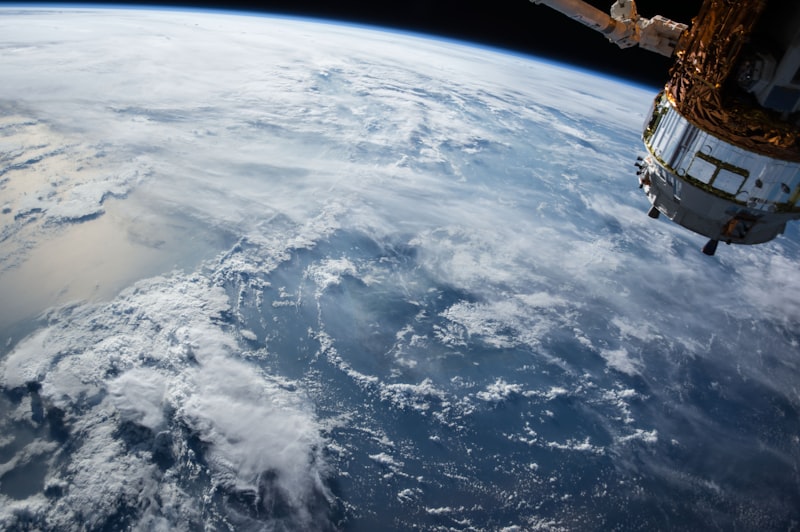
Space is vast, complex, and often difficult to truly comprehend. From black holes to dark energy, the universe keeps surprising even the brightest minds.
The Scale of Space
1. The observable universe is about 93 billion light-years in diameter. To put that in perspective, if you shrank the entire observable universe to the size of Earth, our entire solar system would be smaller than a single atom.
2. There are more stars in the universe than grains of sand on all of Earth's beaches combined. The estimated 100 billion trillion stars vastly outnumber the roughly 7.5 quintillion grains of sand on Earth.
3. The nearest star system to Earth, Proxima Centauri, is 4.24 light-years away. If you could travel at the speed of a commercial jet (900 km/h), it would take over 5 million years to get there.
4. A light-year is about 9.46 trillion kilometers. The Voyager 1 spacecraft, launched in 1977, has traveled about 24 billion kilometers -- that's just 0.0025 light-years in nearly 50 years.
Strange Cosmic Objects
5. Neutron stars are so dense that a single teaspoon of their material would weigh about 10 million tons. They are the remnants of supernova explosions, with diameters of only about 20 kilometers but masses greater than the Sun's.
6. Black holes are regions of spacetime where gravity is so strong that nothing, not even light, can escape. The supermassive black hole at the center of our Milky Way galaxy, Sagittarius A*, has a mass of about 4.3 million Suns.
7. Quasars are the extremely bright centers of distant galaxies, powered by supermassive black holes. The brightest quasar shines with the light of over 600 trillion Suns, making it visible from billions of light-years away.
8. Rogue planets are planets that drift through space without orbiting any star. There may be billions of them in our galaxy alone, ejected from their solar systems during planetary formation.
Mind-Bending Physics
9. Spacetime can be warped by gravity and motion. This warping has been directly measured: clocks on GPS satellites must be adjusted by 38 microseconds per day to account for both special and general relativistic effects.
10. The universe is expanding at an accelerating rate, driven by a mysterious force called dark energy. Dark energy makes up about 68% of the universe's total energy content, but its nature remains unknown.
11. Gravitational waves -- ripples in spacetime caused by massive accelerating objects -- were first directly detected in 2015 by LIGO. The waves from two colliding black holes traveled 1.3 billion light-years to reach Earth.
12. The cosmic microwave background radiation is the 'afterglow' of the Big Bang. This faint microwave radiation fills the entire universe and provides a snapshot of the universe when it was just 380,000 years old.
13. Quantum entanglement in space has been tested over distances of thousands of kilometers using satellites. China's Micius satellite demonstrated entanglement distribution between Earth and space, confirming that the strange rules of quantum mechanics hold even across cosmic distances.
The Unknown
14. We don't know what 95% of the universe is made of. Dark matter (27%) and dark energy (68%) are placeholders for phenomena we observe but cannot explain. We've never directly detected either one.
15. The Fermi paradox asks: if the universe is so vast and old, why haven't we found any evidence of extraterrestrial intelligence? There may be billions of potentially habitable planets in our galaxy alone, yet we see no signs of life.
16. The Great Attractor is a gravitational anomaly pulling our galaxy and millions of others toward it at over 600 km/s. We can't see what it is because it's located behind the 'Zone of Avoidance' -- the dusty plane of the Milky Way.
17. The multiverse theory suggests our universe may be one of countless universes, each with different physical constants and laws. While unproven, this idea emerges naturally from certain interpretations of quantum mechanics and cosmic inflation.